

Comparison of Private vs. Public Markets

Written by Wyck Brown CFA, MBA and Taylor Truitt
The traditional case for investing in private markets focuses on its risk/return advantages vs public markets driven by the large and differentiated opportunity set of private assets, the illiquidity premium, and the operational improvements afforded via active management.
Public markets represent only a portion of the overall corporate universe. The number of publicly listed U.S. companies has declined substantially over the past several decades even as total public-market capitalization has increased. Meanwhile, the population of privately held businesses has grown. Private markets provide access to a much broader universe of businesses in addition to being an alternative source of capital for companies available in public markets.
A Smaller and More Concentrated Public Market
JPMorgan reports that the number of U.S. public companies declined from approximately about 8,000 in 1996 to roughly 4,000 in recent years. Over a similar period, the number of U.S. companies backed by private equity firms increased from approximately 1,900 to 11,200. At the same time, public-market capitalization has continued to grow, reflecting increasing concentration among a relatively small number of very large companies, including the so-called Magnificent Seven.
Companies that choose to go public benefit from access to broad retail and institutional liquidity, potentially higher valuation multiples in certain sectors, the ability to use public equity as acquisition currency, equity compensation for employees, and greater brand visibility. However, the development of private capital markets has given companies more alternatives to an IPO. Remaining private can provide greater flexibility around long-term strategy, capital allocation, ownership structure, and the timing of liquidity events. Private companies also generally face less public-company reporting and less pressure associated with quarterly earnings expectations. These advantages allow owners and management teams to partner with capital providers whose investment horizon may be better aligned with the company's long-term objectives.
Private Equity Is Only One Part of the Private Market
The conventional narrative is that private equity can outperform public markets through an illiquidity premium, better active management, and operational improvements. These factors matter, but they overlook another fundamental characteristic of private markets: the size of the corporate universe available for investment.
There are three distinct segments of the corporate universe:
Public companies: businesses whose shares trade on public stock exchanges.
PE-owned private companies: businesses owned by institutional private-equity firms.
Non-PE-owned private companies: privately held businesses owned by founders, families, management teams, employees, and other investors that represent a vast future opportunity set for PE firms
The second category is often mistakenly treated as synonymous with the private market. Private-equity managers own only a relatively small subset of privately held businesses, while the vast majority remain outside institutional private-equity ownership. These businesses represent potential future private-equity investments, strategic acquisitions, IPO candidates, and other private transactions, creating a continually renewable opportunity set.
A Vast and Underpenetrated Private-Company Universe
S&P Global reported that, as of August 2025, its U.S. private-sector dataset included approximately 2.37 million enterprises, compared with approximately 1.80 million in 2023. Within the 2025 dataset, approximately 82,900 companies were identified as private-equity owned, compared with approximately 62,500 in 2023. On this basis, PE-owned companies represented approximately 3.5% of the identified private-company universe by count. The overwhelming majority of private companies were not owned by private-equity firms.
The scale of this universe is significant, but the number of companies alone does not guarantee investment quality or excess returns. Many private businesses are small, specialized, illiquid, or otherwise unsuitable for institutional investment. The opportunity comes from having a larger population from which to identify the subset of companies with attractive fundamentals, management teams, industry dynamics, and valuations.
The Investment Implication
Several structural trends continue to support this opportunity. Companies are remaining private longer, private capital is increasingly available, and business owners have more alternatives to a traditional IPO. Regulatory changes could influence the balance, but the longer-term trend has been toward a larger private-company universe and greater availability of private capital.
The key distinction, therefore, is not simply between public and private equity, but between accessible and inaccessible portions of the corporate universe. Public markets offer liquidity and transparency, but investors are increasingly concentrated in a relatively small number of listed companies. Traditional private equity provides access to another subset of businesses, but PE ownership itself represents only a small fraction of privately held companies.
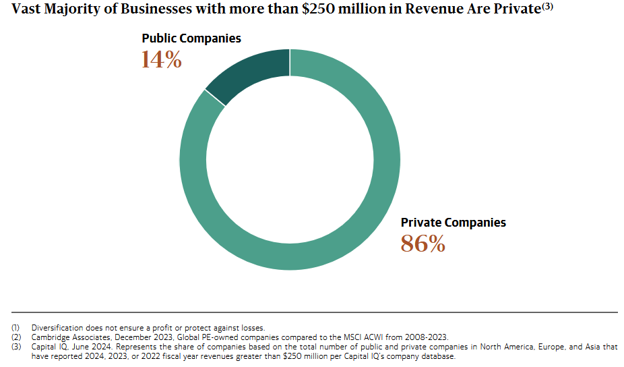
Between these groups lies a much larger population of privately owned businesses that remains relatively underpenetrated by institutional capital. If we take the number of businesses with more than $250 million in revenue, we can exclude some of the smaller businesses that will likely never be investable and still show the same story. According to Blackstone, 86% of companies over the $250 million threshold are private. This provides exposure to areas that are underrepresented or unaccounted for in public markets, which can increase diversification and defend against market downturns.
For investors capable of sourcing, evaluating, and selectively investing in these businesses, the breadth of the private-company universe may be one of the most important structural advantages of private-market investing. The opportunity is therefore not simply the potential for an illiquidity premium or active-management alpha. It is access to a much broader and continually evolving universe of companies than exists in today's increasingly concentrated public markets.
Sources
JPMorgan Chase - 2023 Annual Report
S&P Global - California, Massachusetts, Utah Lead in U.S. Private Equity Penetration