New Chapter for the Fed

Written by Wyck Brown, CFA, MBA and Katherine Mendoza
Warsh’s Return to the Fed
Kevin Warsh took over as the Federal Reserve Chair on May 22, 2026, succeeding Jerome Powell. Warsh is no stranger to the Fed, as he served as a Fed governor from 2006-2011 and was there during the financial crisis. Now he is returning as Chair and is walking into elevated federal debt and borrowing needs, geopolitical tensions and associated energy and supply pressures, a divided Federal Open Market Committee, and inflation exceeding the 2% target. The Fed’s dual mandate calls for maintaining maximum employment and price stability, a balancing act made increasingly complex by persistent inflation alongside resilient economic growth. This could prove to be one of the more consequential recent leadership transitions, as Warsh’s concern isn’t just what rates should be, but how the Fed should be making that decision in the first place. Warsh brings a strong preference for a small Fed footprint and has created five task forces to examine current practices central to monetary policy.
The Five Task Forces
The Communications Task Force has been established to review how the Federal Reserve conveys policy decisions among uncertainty, including the role of broader forward guidance. Warsh believes the Fed has demonstrated too much precision about an uncertain future, as projections that understate the uncertainty can lead investors to place too much confidence in future rates. At Warsh’s first meeting as Chair, he declined to file his own rate projection, stating that he didn’t believe it would be helpful in the conduct of policy. This decision demonstrates an early indication of the reduction in forward guidance that Warsh seems to favor, shifting more responsibility to markets to assess economic conditions and price future policy. While the greater Fed flexibility may improve price discovery and give the Fed greater flexibility, this could also lead to more uncertainty and higher term premiums as the markets will have to independently price the future path of monetary policy.
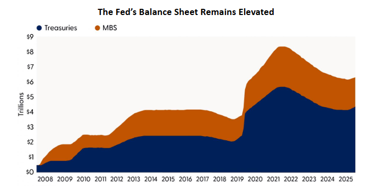
The Balance Sheet Policy Task Force will examine institutional implications of the Federal Reserve’s current balance sheet regime. Before the Global Financial Crisis, the Fed had a relatively small balance sheet, but that changed with the use quantitative easing (QE), which was employed again extensively during COVID. Warsh argues that rather than being a routine part of monetary policy, QE should be an emergency tool used only in exceptional situations. Another concern is the current ample-reserves regime, where banks hold significantly more reserves than they did before 2008, and if the Fed can substantially shrink its balance sheet while maintaining an ample-reserves system. These changes would reduce the Fed’s presence in financial markets, but could also mean less support during periods of market stress.
Source: LPL Research, Bloomberg 05/05/26
The Data Task Force will set out to improve the quality and timeliness of real economic signals that inform the Fed’s policy decisions. Traditional economic data are often lagged and revised after their release. More timely, higher-quality data would allow the Fed to more confidently evaluate the current economic situation and respond as conditions evolve. This will assist in decreasing the emphasis on predicting the future and increasing the importance of having a clearer understanding of the present.
The Productivity and Jobs Task Force will assess the economic impact of new technologies, including AI, to inform the Fed’s policy judgments. More efficient technology could lead to higher productivity, allowing the economy to grow faster without generating as much inflation. However, productivity gains from AI are still uncertain, so there’s a risk of overestimating the economy’s capacity to grow without inflation.
The Inflation Frameworks Task Force will revisit how the Federal Reserve understands and responds to the drivers of inflation. Warsh places significant responsibility on the Fed and monetary policy as the sources of persistent inflation, although he does acknowledge that external factors, such as energy price shocks and tariffs, can influence inflation over shorter periods. They will evaluate the existing inflation framework from the ground up, while maintaining the credibility of its 2% inflation target.
Looking Forward
It is early in Warsh’s tenure, but the formation of these task forces shows that he is willing to reconsider many of the Fed’s current processes. The direction Warsh wants to take seems to be clear - less Federal Reserve involvement in the markets and greater emphasis on current conditions rather than forecasts of future conditions – but how these ideas will all be implemented and their success remains to be seen. Warsh’s ability to implement these changes while navigating the evolving economy will determine if this will spur a lasting change in the Fed’s use of monetary policy.
Sources
“A New Fed Regime: Warsh, Policy Direction, and Treasury Market Consequences.” Scarbroughfinancial.Com, 2026, https://scarbroughfinancial.com/individualarticle.php/5-11-26-a-new-fed-regime-warsh-policy-direction-and-treasury-market-consequences.
“Chairman’s Task Forces for Advancing Monetary Policy.” Federalreserve.Gov, 2026, https://www.federalreserve.gov/monetarypolicy/task-forces.htm.
Konstantin Milevskiy. “The Slate.” FOMC Insight Engine, 2026, https://causalityineconomics.com/blog/the-slate.
Favorito, Joseph M. “Quantitative Easing & the Fed Balance Sheet – Landmark Wealth Management.” 2025. https://landmarkwealthmgmt.com/articles/quantitative-easing-the-fed-balance-sheet/