Participant Education: Friend or Foe?

By Amy Hanophy, QPFC®, CRPS® and Dustin Roberts, MBA, QKA, AIF®
"Never, ever, think about something else when you should be thinking about the power of incentives." — Charlie Munger
Participant education is widely viewed as a cornerstone of successful retirement outcomes; done well, it helps employees make informed decisions, improve savings behavior, and manage investment risk. But not all education is created equal. Increasingly, what is delivered under the banner of "education" is conflicted and structured to steer participants toward products or services that generate revenue for a service provider. For plan sponsors, this is not abstract: you select and monitor the advisor or recordkeeper firm who in turn educates your participants, and that carries fiduciary weight. So, the question is worth asking: is the education your participants receive always in their best interest, or has it quietly become a vehicle for sales?
Why the pressure is increasing
Follow the economics. The retirement plan business has consolidated sharply: as of 2023, the top ten DC recordkeepers held 78 percent of industry assets, up from 56 percent in 2013, while recordkeeping fees compressed by 25 to 35 percent.[1] Private equity firms and financial companies backed by private equity have acquired more than 900 independent retirement and wealth-management practices over the past decade, drawn less by the plan-level advice business than by the profit opportunity one step beyond the plan. Over 90% of DC aggregators now offer one-on-one participant advice.[2]
A workplace plan is, in effect, a captive population of future retail clients. Converting participants into wealth-management clients turns a low-margin institutional relationship into a high-margin, recurring one, often at several times the fee and since the provider already has trusted access, the cost of acquiring that client is near zero. Annual IRA rollover contributions more than doubled between 2013 and 2022, to about $770 billion.[3] Private-equity ownership adds a deadline, often targeting an exit strategy within a few years, so a high-margin rollover opportunity next to a fixed clock becomes a structural incentive to push.
Higher fees, fewer protections
The direct consequence is that participants get nudged into retail accounts that cost more. Workplace plans hold costs down through institutional pricing and fiduciary oversight; roll assets out and participants typically face layered fees totaling 1% or more a year, which compound and hit smaller balances hardest. On a hypothetical $500,000 balance growing at 6% annually, a 0.75-point fee difference costs roughly $203,000 over 20 years.
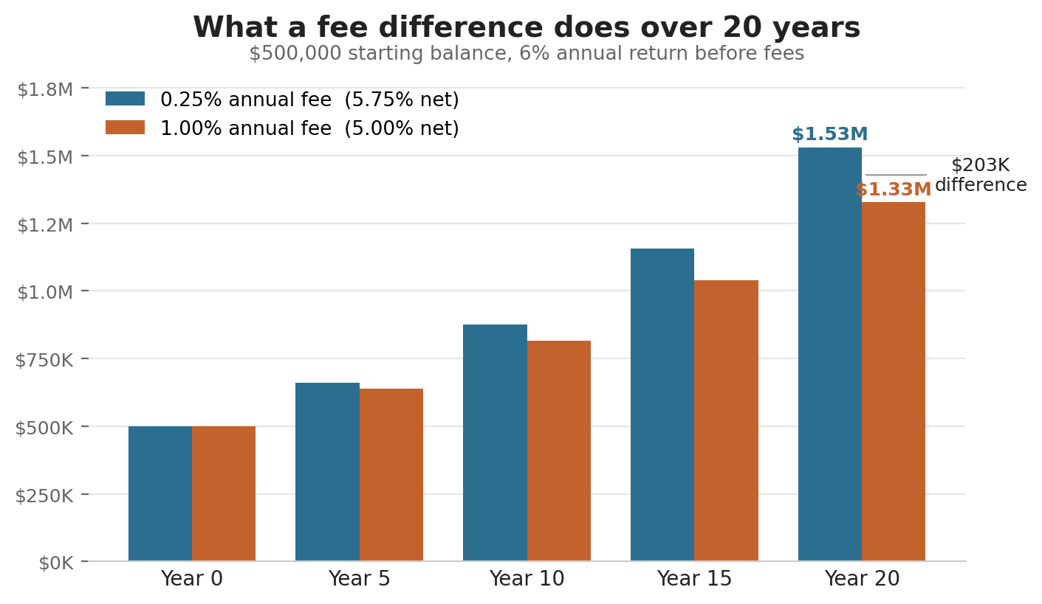
Hypothetical growth of a $500,000 balance over 20 years at a 6% annual return, net of a 0.25% versus a 1.00% annual fee. The 0.75-point fee difference costs roughly $203,000 by year 20. For illustration only; actual results will vary.
Leaving the plan can also mean leaving behind ERISA-governed fiduciary protection, a trade-off conflicted education rarely spells out. Managed accounts, often pitched as personalized oversight, typically add 0.30% to 0.75% on top of investment expenses even though low-cost options like target-date funds may serve many participants just as well. Notably, managed-account services will not recommend against themselves or toward a lower-cost target-date fund.
In one case, Innovest found an advisor charging participants 1% to manage $100 million in brokerage-window assets accumulated over nearly 20 years, about $1 million in annual revenue, roughly 15 times typical benchmarks for a retirement plan advisor.
What good education looks like
Unconflicted education is compensated through a transparent, level fee, with no added pay tied to participant choices. The agenda is set by participant needs, treats staying in the plan as fully legitimate, and measures success in participant-focused outcomes rather than vendor-focused assets captured. The test is simple: would the education look the same if the provider had nothing else to sell?
What plan sponsors should watch for
Be attentive to language like "financial wellness" and "personalization." While often genuine, they are frequently entry points for higher-margin offerings. What matters is the substance: what the service costs, who benefits financially, and whether it advances the participant's outcomes or the provider's revenue. Key questions to ask your provider:
How is it compensated, and does revenue rise when participants roll assets out or adopt a particular product? Request written disclosure of every revenue source, including affiliate compensation.
Does the firm or an affiliate offer the wealth-management services participants are guided toward? If so, request its conflict-of-interest policy and how educators are paid when a participant converts.
Is staying in the plan genuinely viable for retirees, or does plan design quietly encourage rollovers? Review distribution options and fees with your committee and document the analysis.
These questions go to the heart of the fiduciary duties of loyalty and prudence.
Conclusion
Participant education remains essential to retirement readiness, but its value depends on its integrity. When education blends guidance with sales incentives, it can undermine the outcomes it's meant to support through higher fees, reduced protections, and biased recommendations participants may never recognize.
At Innovest, we believe most participants are best served by keeping assets in the plan, where costs are generally lower, and where we receive no additional revenue when managed accounts make sense. Preserving the value of participant education comes down to transparency, a clear separation between education and sales, and a commitment to participant-first practices so education can serve as a true friend, rather than a hidden foe, in the pursuit of financial security.
[1]McKinsey & Company, "The US retirement industry at a crossroads," April 16, 2025
[2]PIMCO, "Executive Summary PIMCO Defined Contribution Consulting Study," 2026
[3]McKinsey & Company, "The US retirement industry at a crossroads," April 16, 2025