

The IPO Dream vs The IPO Reality
Steven Karsh, MBA and Brooklyn Seymour
Investors have always been captivated by initial public offerings (IPO). The appeal and excitement around IPOs are easy to understand because if you buy the next Google, Amazon, or Tesla at the beginning of its journey, it could potentially turn a modest investment into life-changing wealth. Entire generations of investors have grown up hearing stories about early shareholders who held these stocks through decades of explosive growth. Today's anticipated public offerings have revived that excitement. SpaceX, OpenAI, and Anthropic represent companies that have already achieved scale and influence rarely seen before an IPO. Unlike many past listings, these firms could potentially and have debuted with valuations measured not in billions, but in trillions of dollars. For investors, the temptation is obvious when people are wondering if this is the next massive wealth opportunity. The reality, however, is more nuanced.
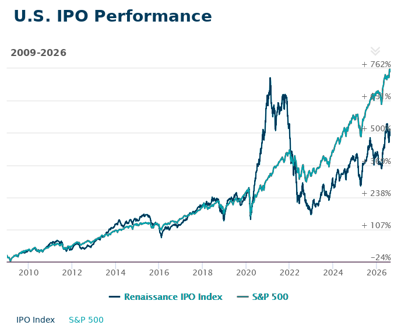
Source: Renaissance Capital IPO Center. Renaissance IPO Index and S&P 500 performance data, accessed August 2026Renaissance Capital IPO Center. Renaissance IPO Index and S&P 500 performance data, accessed August 2026.
The IPO Performance Gap
Investors tend to recall the IPO market's big winners, forgetting the larger group that never lived up to expectations. As the chart comparing the Renaissance IPO Index to the S&P 500 shows, IPOs can outperform dramatically but with far greater volatility; surging during the low-rate years of 2020–2021, then falling sharply as conditions shifted.
Historically, IPO investing has been a game of extremes. A small number of winners often generate most of the gains, while many newly public companies struggle to meet the optimism embedded in their initial valuations. Investors naturally remember Tesla and Google. They rarely talk about the thousands of IPOs that failed to become household names. This creates an important lesson: success stories are memorable precisely because they are unusual.
Why Today's IPOs Are Different
The next wave of IPOs looks fundamentally different from those that came before. Historically, companies typically went public earlier in their corporate lifecycle. Investors gained access while businesses were still rapidly expanding and often unprofitable. Today, abundant private capital allows companies to remain private much longer. Venture capital firms, sovereign wealth funds, and large institutional investors can provide financing that once required access to public markets. As a result, companies such as SpaceX, OpenAI, and Anthropic may enter public markets as mature businesses with hundreds of billions, or even trillions, of dollars in valuation already attached to them.
In many ways, public investors are no longer buying the startup phase. Instead, they are buying the next chapter and that distinction matters because much of the explosive growth that created fortunes for early investors may have already occurred while these companies were private.
Direct Stock Investing vs. Index Investing
When a highly anticipated IPO arrives, investors often focus exclusively on buying shares of the company itself. Yet most Americans ultimately gain exposure through index funds rather than direct stock ownership. This difference is significant as a direct investor is making a concentrated bet on a single company. If the firm becomes the next Tesla, the rewards can be enormous. If expectations prove unrealistic, losses can be equally substantial.
Index investors get a different outcome, because instead of betting on one company, they gain exposure to a diversified basket. When a major IPO joins an index like the S&P 500, every fund tracking that benchmark becomes a buyer, so many investors may end up having exposure to SpaceX, OpenAI, or Anthropic automatically through their retirement accounts and index funds, without ever consciously buying the stock.
Why Float Matters More Than Valuation
One of the most misunderstood aspects of index inclusion is "float." A company's headline valuation often receives the media attention, but index providers care far more about how many shares are actually available for public investors to buy. Float refers to the percentage of shares freely available for trading. Shares held by founders, insiders, strategic investors, or governments are excluded from float calculations because they are not available trade for an extended period of time.
This distinction is particularly important for anticipated mega-IPO candidates.
SpaceX illustrates how float-adjusted market cap shapes index inclusion. Despite a $2 trillion+ valuation, only about 4% of its shares were publicly available, per Morningstar. Resulting in giving it a float-adjusted S&P 500 weight of just 0.13%, versus 3.08% without the adjustment. The same process will apply to OpenAI and Anthropic, where founders and strategic investors are expected to retain large ownership stakes, limiting public float.
The New Fast Track Into Indexes
Historically, newly public companies spent months or years on the sidelines before earning a meaningful place in major indexes, but that timeline is changing. Index providers have increasingly built fast-entry mechanisms to accommodate exceptionally large IPOs, and Nasdaq's rules now let major listings join the index far sooner than before.
Below are the nuances for inclusion into each major index provider:
S&P 500: Committee-selected; requires size, liquidity, U.S. domicile, sufficient float, and a history of positive GAAP earnings.
Nasdaq-100: More rules-based; ranks Nasdaq-listed companies mainly by market value and liquidity, with no profitability requirement.
Russell Indexes: Reconstituted annually, but qualifying IPOs can now be reviewed quarterly, allowing large new listings to enter sooner.
MSCI USA/World: Uses quarterly reviews and fast-entry rules so very large, liquid IPOs can be added quickly to global benchmarks.
The allure of IPOs will not fade. Investors will always look for the next company capable of creating extraordinary wealth, but history argues for discipline and most IPOs do not become the next Tesla or Google, in fact many reach public markets only after much of their growth has already occurred. For investors, the bigger question may be what happens after the IPO, how much stock is freely tradable, how quickly the company enters major indexes, and how much demand is created by index funds required to own it. In an era of mega-cap private companies and potential trillion-dollar listings, the path to index inclusion may matter just as much as the IPO itself.